


Most coronary angiogram quotes in Chennai land around ₹25,000. In practice the range runs from roughly ₹15,000 to ₹36,000, and what moves you within it is mostly the hospital, whether the test is billed as day care or as an admission, and the room category you choose — not the procedure itself.
The numbers, September 2026
- Typical private quote: around ₹25,000
- Usual range: ₹15,000 to ₹36,000
- CGHS rate, accredited hospital: ₹13,400, revised 13 October 2025
- CMCHIS, Tamil Nadu: no diagnostic package
Almost nobody looks up the price of an angiogram until a doctor has just suggested one — usually straight after a treadmill test that did not look right. Then the search begins, and it produces chaos: one site says ₹12,000, another says ₹48,000, and the hospital's front desk gives a third number that changes again when the bill arrives.
None of those sites is necessarily lying. They are counting different things, and some are quoting a different kind of patient altogether. Here is how the number is actually built.
What you are paying for
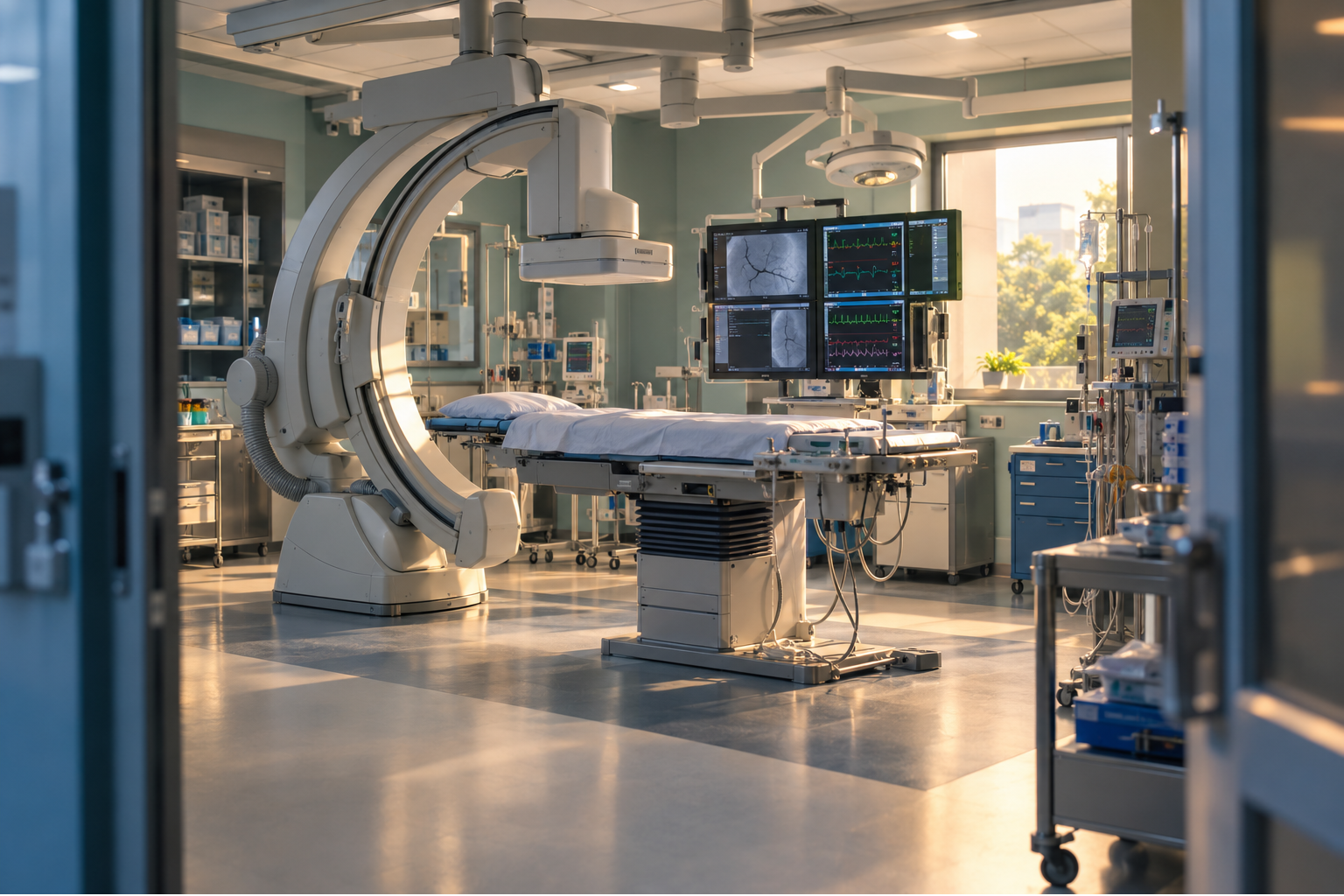
A coronary angiogram is a diagnostic test, not a treatment. A thin catheter is passed from the wrist or the groin to the heart, dye is injected into the coronary arteries, and X-ray images show where the arteries are narrowed and by how much. Nothing is repaired during the test itself.
The bill is built from five things:
- Catheter lab time — the room, the X-ray system, the technicians and nursing staff.
- Consumables — the sheath, the diagnostic catheters, the guidewire, a closure device if one is used. Single-use, and the component that varies most between hospitals.
- Contrast dye — charged by the volume used.
- Professional fees — the cardiologist performing the study, and an anaesthetist if sedation is used.
- Room and observation — anywhere from four hours in a day-care bay to a night on the ward.
Pre-procedure investigations typically add ₹2,000 to ₹7,000 on top. That is the part most telephone quotes leave out, and a common source of surprise on the final bill.
Why the quotes differ so much
The access route. A radial angiogram — through the wrist — usually means you sit up within an hour and go home the same evening. A femoral angiogram — through the groin — needs several hours lying flat and often an overnight stay. Radial costs slightly more in consumables and saves considerably more in room charges. It is also the default in most modern labs for clinical reasons, not billing ones.
Day care versus admission. Many insurers price a day-care angiogram quite differently from an admitted one. This single classification can move the number more than any consumable.
The room category. In most hospitals the ward class you choose scales the professional fees and the procedure charge, not just the bed rate. Ask explicitly whether this applies before you pick a room.
What the government pays, and why it matters
CGHS pays ₹13,400 for coronary angiography at an accredited hospital in Chennai, under rates revised on 13 October 2025. A non-accredited hospital is paid 15% less. Note that this sits below the cheapest routine private quote in the city — which is precisely why some hospitals are reluctant to take CGHS cases for this test.
CMCHIS, the Tamil Nadu scheme, has no package for a diagnostic angiogram at all. Its cardiology cover begins at treatment: ₹50,400 for primary angioplasty, ₹66,200 for angioplasty with a stent, ₹18,700 for each additional stent. If you hold a CMCHIS card and have been told you need an angiogram, this is worth knowing before you arrive.
A note on what you will find online. Some of the highest figures you will see — ranges topping ₹48,000 — come from medical tourism facilitators quoting package rates for international patients flying in. Those are real prices for that audience and misleading for a family in Chennai. Check who is publishing a number before you trust it.
What to ask before you agree
Ask for the estimate in writing, itemised, and ask these four questions:
- Is this quoted as day care or as an admission?
- Does it assume radial or femoral access?
- What is not included — pre-procedure blood tests, echocardiogram, the pre-anaesthetic review, discharge medicines?
- If the angiogram shows a blockage that needs treating in the same sitting, what is the revised estimate, and who authorises it?
The fourth matters most and is the one people forget.
If the angiogram shows a blockage
Sometimes a narrowing should be treated immediately — the catheter is already in place, and a second procedure on another day means a second set of costs and a second recovery. Sometimes the right answer is to stop, study the images properly, and plan.
That decision depends on which artery is involved, how calcified it is, whether one vessel is affected or three, and on your kidney function and diabetes status. It is a conversation, not an automatic next step. Where treatment is needed, angioplasty and stenting — including calcified and complex blockages in patients advised against bypass surgery — are performed at Kauvery Heart Institute, Radial Road.
You are entitled to ask for the angiogram images on a CD or drive before any treatment decision is made. A second opinion on those images is reasonable, and no cardiologist should take offence at the request.
What insurance covers, and what it does not
Most Indian health policies cover a coronary angiogram when it is clinically indicated and pre-authorised. The usual gaps are outpatient pre-procedure investigations, the consultation that led to the referral, and discharge medicines. Policies with a waiting period for pre-existing conditions may exclude it if hypertension or diabetes was declared recently.
One thing you cannot look up: what your own insurer will actually pay. Those are negotiated network tariffs, confidential by contract, and they differ hospital by hospital and by room class. Read the pre-authorisation letter, not the brochure.
When to see a cardiologist in Tambaram
An angiogram is worth discussing — not necessarily doing — if you have chest discomfort on exertion that settles with rest, a treadmill test reported as positive or equivocal, breathlessness worsening over weeks, or a strong family history of early heart disease alongside symptoms.
At SR Heart Clinic on Elangovan Street, Tambaram, a consultation includes an ECG, an echocardiogram with Doppler where indicated, and an NT-proBNP blood test with the result available the same evening. That is usually enough to establish whether an angiogram is the right next step at all, or whether the symptoms point elsewhere. Bring previous ECGs, treadmill reports and your current medicine list.
Questions patients ask
Is a CT angiogram cheaper than a conventional angiogram?
Usually, and it needs no catheter. CGHS pays ₹9,200 for CT coronary angiography with calcium scoring at an accredited hospital in Chennai, against ₹13,400 for the conventional test. But heavy calcium can make a CT unreadable, and it cannot treat anything.
Why does the hospital quote change after admission?
Most often because the room category was upgraded, femoral access was used instead of radial, or pre-procedure tests were added. Ask for the itemised estimate before admission and keep a copy.
How long does a coronary angiogram take?
The procedure is usually 15 to 30 minutes. The day around it is longer — admission, preparation, the study, then observation: four to six hours for a radial day-care case.
Can I eat before an angiogram?
You will usually fast four to six hours for solids. Most regular medicines continue with a sip of water. Diabetes medicines and blood thinners need specific instructions — ask at the pre-procedure visit, not on the morning.
For a discussion about whether an angiogram is the right next step, see Dr. Stalin Roy J at SR Heart Clinic.
🩺 Coronary Angiogram — cost on consultation
📍 Elangovan Street, Tambaram · Mon–Fri, 6:30–7:30 PM
📞 080 4369 2777 · WhatsApp 70606 76067
🔗 https://www.srheartclinic.com/coronary-angiogram/7
This is general awareness, not personal medical advice.