

What is an ECG?
An Electrocardiogram (ECG) is one of the most commonly performed heart tests. It records the electrical activity of the heart using small sensors placed on the chest, arms, and legs.
The test is quick, painless, and inexpensive, and it provides valuable information about the heart.
However, many people mistakenly believe:
“If my ECG is normal, my heart must be normal.”
This is not always true.
What Can an ECG Diagnose?
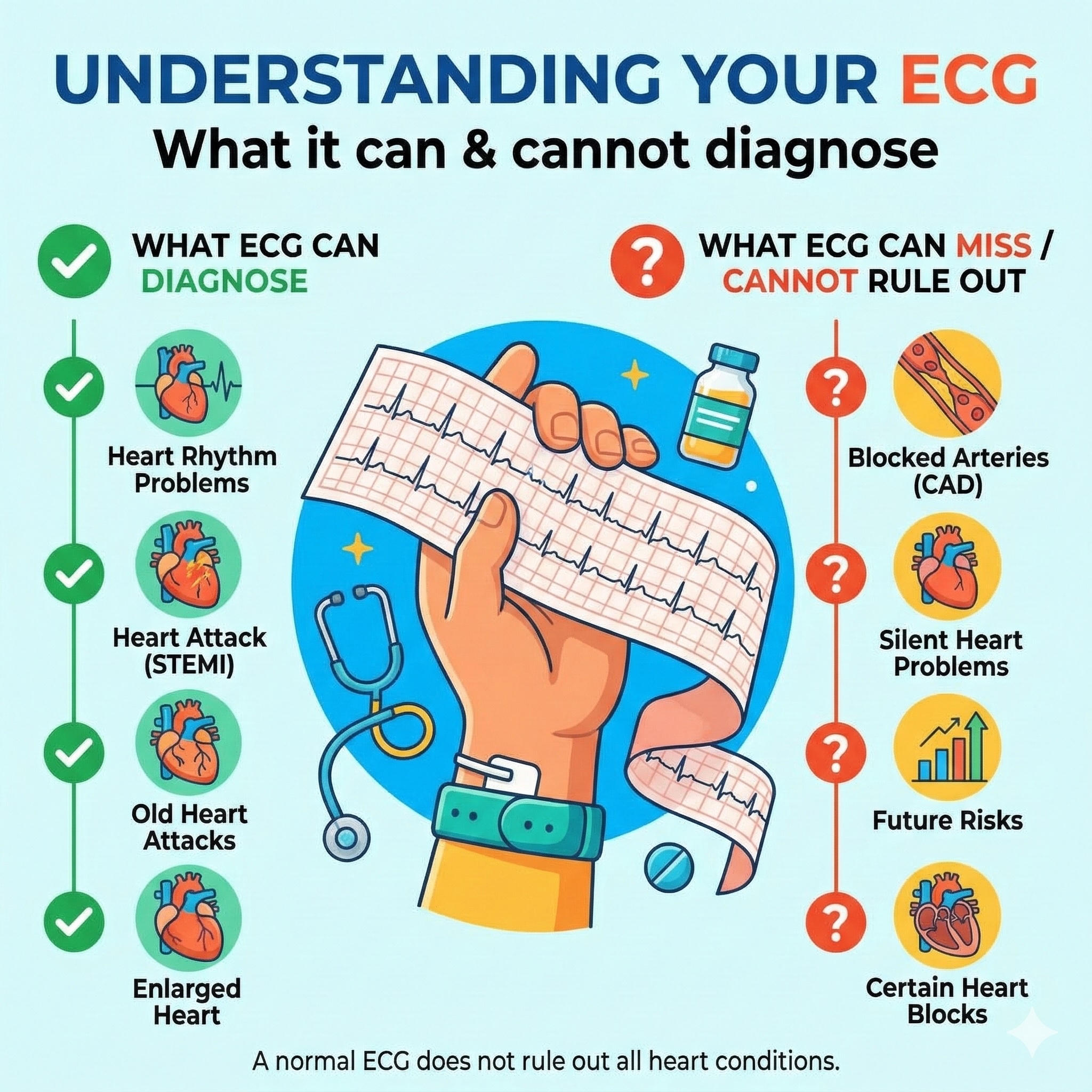
An ECG is very useful for detecting several heart conditions, including:
1. Abnormal Heart Rhythms (Arrhythmias)
ECG can identify irregular heart rhythms such as:
Atrial fibrillation
Tachycardia (fast heart rate)
Bradycardia (slow heart rate)
2. Evidence of Previous Heart Attack
Sometimes an ECG can show signs that a heart attack occurred in the past.
3. Acute Heart Attack (in some cases)
In many patients, especially those with ST elevation myocardial infarction (STEMI), the ECG clearly shows signs of a heart attack.
4. Electrolyte Abnormalities
Conditions like high potassium levels may produce characteristic ECG changes.
5. Certain Structural Heart Problems
ECG may suggest:
Thickened heart muscle (hypertrophy)
Conduction abnormalities
What an ECG Cannot Reliably Diagnose
Despite its usefulness, an ECG has important limitations.
1. A Normal ECG Does NOT Always Rule Out a Heart Attack
Many patients with Non-ST Elevation Heart Attack (NSTEMI) can have a completely normal ECG initially.
In such cases, diagnosis requires:
Blood tests (Troponin)
Clinical symptoms
Repeat ECGs
This is why doctors take chest pain seriously even if the ECG looks normal.
2. A Normal ECG Does NOT Always Rule Out Heart Block
Heart blocks are problems in the electrical conduction system of the heart.
Some types of heart block:
Occur intermittently
May not appear during the short ECG recording
These may only be detected using:
Holter monitoring
Event recorders
Long-term rhythm monitoring
3. ECG Cannot Detect Blockages in Heart Arteries
An ECG cannot directly show coronary artery blockages.
For that, doctors may recommend:
TMT (Stress Test)
CT Coronary Angiogram
Coronary Angiography
Why Doctors Sometimes Order Multiple Tests
A heart diagnosis is never based on ECG alone.
Doctors combine:
· Symptoms
· Physical examination
· ECG
· Blood tests
· Echocardiography
· Stress testing
· Imaging
to arrive at the correct diagnosis.
The Key Message
A normal ECG is reassuring — but it does not always mean the heart is perfectly normal.
If you have symptoms such as:
· Chest pain
· Breathlessness
· Palpitations
· Dizziness or fainting
you should seek medical evaluation even if an ECG appears normal.